Hey, kids, welcome to the Phile for a Monday. How are you? One day 2020 will be the one-word catchphrase for everything messed up and band; "How's your day?" "A total 2020." "Say no more..." "Full House" star and former Hallmark Channel regular Lori Loughlin has been sentenced to two months in prison for her role in paying bribes to get her daughters into the University of Southern California. Loughlin had previously pleaded guilty to conspiracy charges in May.
The sentencing hearing, which took place over Zoom due to COVID-19 restrictions, also saw Loughlin hit with a $150,000 fine and 100 hours of community service. US district judge Nathaniel Gorton presided. Loughlin and her husband, fashion designer Mossimo Giannulli, were indicted in “Operation Varsity Blues” in March 2019 along with dozens of other wealthy and famous individuals who bribed their kids’ way into elite colleges by falsely placing them on athletic teams or helping them cheat on their SATs or ACTs.
Loughlin and Giannulli were accused of spending $500,000 in bribes to the college scam’s ringleader, William “Rick” Singer, to get their daughters into USC by posing them as members of the rowing team. Loughlin’s daughters, Isabella Rose Giannulli and Olivia Jade Giannulli were not charged with any crimes.
Giannulli, who was found to be the more active participant between himself and Loughlin in the family’s role in the scandal, was sentenced to five months in prison, ordered to pay a $250,000 fine, and complete 250 hours of community service.
Loughlin apologized for her role in the scandal, telling the judge, with tears in her eyes, that she understands that her actions exacerbated existing inequalities in the education system.
Back in September of 2019 the other high profile celebrity involved in the Varsity Blues scandal, Felicity Huffman of "Desperate Housewives" fame, was sentenced to 14 days in prison for paying $15,000 to have her daughter’s incorrect test answers corrected (unbeknownst to her daughter). Huffman, who unlike Loughlin admitted guilt as soon as she was caught, ended up only serving 11 days.
The Golden State Killer, 74-year-old Joseph James DeAngelo, will spend the rest of his life in prison without the possibility of parole for a string of nearly 50 rapes and 13 slayings that terrorized California for decades. A Sacramento judge sentenced DeAngelo to multiple life sentences on Friday, burning an end to the case of one of the nation’s more infamous and prolific serial predators.
The sentence was expected after DeAngelo reached a plea deal with prosecutors in six California counties. The plea required him to plead guilty or admit his guilt in dozens of crimes in exchange for being spared the possibility of the death penalty. DeAngelo showed no emotion as the sentence was read by Sacramento County Superior Court Judge Michael Bowman. He sat in between his public defenders while wearing a surgical mask and a white sweatshirt.
Bowman praised the detectives and victims who worked to bring the serial rapist to justice, making sure DeAngelo understood the enormity of his awful crimes. He told the defendant, “When a person commits monstrous acts, they need to be locked away so they don’t hurt other people.” The two-hour sentencing hearing followed three days of testimonies from dozens of victims, who described in gruesome detail the attacks that left them robbed and scared of them of innocence and their loved ones.
Joseph DeAngelo was described as a “sick monster,” a “subhuman,” and a “horrible man.” The daughter of one of the victims raised her middle finger while testified, telling DeAngelo he could go to hell. Another detailed testimony spoke about how the girl woke up from a nap as a 7-year-old in the mid-70s to find DeAngelo wearing a mask standing over her mother who had been bound, gagged, and raped in their Sacramento-area home. The woman, who compared the killer to fictional serial killer Hannibal Lecter, stated he had told her mother he might cut off her daughter’s ear and bring it to her if the girl woke the girl.
DeAngelo’s victims were numerous which is why the sentencing hearing was staged in Sacramento State University ballroom to make more space and offer social distancing due to the coronavirus. DeAngelo, who never publicly addressed his crimes, stood up and offered an apology before he was sentenced. He stated, “I’ve listened to all your statements. Each one of them, and I am really sorry to everyone I’ve hurt.” DeAngelo’s spree of killing and raping stretched from 1975 to 1986 and spanned a wide geographical area that authorities initially thought there were multiple suspects. He was alternately known as the “East Area Rapist,” “The Original Night Stalker,” the “Visalia Ransacker,” and finally “The Golden State Killer.”
Situations like these are the reasons why CPR training is important to have, whether you’re a home healthcare worker or a fast food worker. And Sonja Frazier, a Taco Bell employee in Clarksville, Tennessee, showed how useful the training is when she saved a man’s life, after he seemingly passed out in the drive-thru line last Wednesday.
Sonja realized something was very wrong when she noticed how long the line was getting at the Tennessee drive-thru window. She told WSMV, an NBC affiliate, “That’s when I tried to find a pulse because I noticed when we got him out, his ears, lips, fingertips, everything was blue,” which is a very good observation to make in a situation like this. Full disclosure, I don’t think many people could make the deduction so calmly, considering many would be freaking out, not knowing what to do.
So Sonja went immediately into action, looking for a pulse. Again, another correct action to take in a situation like this. She pulled the unconscious man into the parking lot, and starting to perform CPR compressions on him once she realized how vague is pulse was. I have to commend her judgments in this incident because, again, I don’t think many people could make the right decision under this kind of pressure like she did.
She told Clarksville Now, “I started CPR until the fire truck came. It seemed like it took a while,” detailing what she did, she continued, “I pulled his jaw down. He gasped. I kept talking to him. I asked (my co-worker) to see if he had a license so I could call him by name. I kept calling him by his last name and talking to him.”
After turning him over to the first responders, Sonja finally let go of the emotions she was so bravely holding in to save this man’s life, and “went and smoke a cigarette and cried like a baby.” According to WSMV, the man actually reached out to her on Facebook to thank her for saving his life.
In a humble response, she said, “He reached out to me and told me he was okay and that I saved his life, and he didn’t know how to repay me, and I told him that was payment enough, to know that he was okay.”
And even to have such humility after saving a customer’s life is so commendable. Luckily, Sonja actually has a background in healthcare which is how she was able to act quickly and smartly under the pressure. Crazily enough, this is her third time doing CPR at work, and she’s thankful she was there since she normally works the night shift. And heeding words from wise ones like her, she recommends that people get certified as well.
Joe Biden accepted the Democratic presidential nomination with a vow to be a unifying “ally of the light” who would move an America in crisis past the chaos of President Donald Trump’s tenure.
In his strongest remarks of the campaign, Biden spoke Thursday night both of returning the United States to its traditional leadership role in the world and of the deeply personal challenges that shaped his life. Virtually every sentence of his 22-minute speech was designed to present a sharp, yet hopeful, contrast with the Republican incumbent. “Here and now I give you my word: If you entrust me with the presidency, I will draw on the best of us, not the worst. l’ll be an ally of the light, not the darkness,” Biden said. “Make no mistake, united we can and will overcome this season of darkness in America.”
For the 77-year-old Biden, the final night of the Democratic National Convention was bittersweet. He accepted a nomination that had eluded him for over three decades because of personal tragedy, political stumbles and rivals who proved more dynamic.
But the coronavirus denied him the typical celebration, complete with the customary balloon drop that both parties often use to fete their new nominees. Instead, Biden spoke to a largely empty arena near his Delaware home.
Afterward, fireworks lit the sky outside the arena, where supporters waited in a parking lot, honking horns and flashing headlights in a moment that finally lent a jovial feel to the event.
The keynote address was the speech of a lifetime for Biden, who would be the oldest president ever elected if he defeats Trump in November. Trump, who is 74, publicly doubts Biden’s mental capacity and calls him “Slow Joe,” but with the nation watching, Biden was firm and clear.
Still, the convention leaned on a younger generation earlier in the night to help energize his sprawling coalition.
Tammy Duckworth, an Illinois senator who lost her legs in Iraq and is raising two young children, said Biden has “common decency.”
Cory Booker, only the ninth African-American senator in U.S. history, said Biden believes in the dignity of all working Americans.
And Pete Buttigieg, the 38-year-old former South Bend, Indiana, mayor and a gay military veteran, noted that Biden came out in favor of same-sex marriage as vice president even before President Barack Obama.
“Joe Biden is right, this is a contest for the soul of the nation. And to me that contest is not between good Americans and evil Americans,” Buttigieg said. “It’s the struggle to call out what is good for every American.”
Above all, Biden focused on uniting the nation as Americans grapple with the long and fearful health crisis, the related economic devastation, a national awakening on racial justice... and Trump, who stirs heated emotions from all sides.
Biden’s positive focus Thursday night marked a break from the dire warnings offered by Obama and others the night before. The 44th president of the United States warned that American democracy itself could falter if Trump is reelected, while Biden’s running mate, Kamala Harris, the 55-year-old California senator and daughter of Jamaican and Indian immigrants, warned that Americans’ lives and livelihoods were at risk.
Biden’s Democratic Party has sought this week to put forward a cohesive vision of values and policy priorities, highlighting efforts to combat climate change, tighten gun laws and embrace a humane immigration policy. They have drawn a sharp contrast with Trump’s policies and personality, portraying him as cruel, self-centered and woefully unprepared to manage virtually any of the nation’s mounting crises and policy challenges.
Vice President Mike Pence, interviewed Friday on several morning talk shows, criticized Democrats as presenting “a very grim picture of the United States” and said the Republican National Convention next week will focus on what Trump has accomplished, including on the economy and with his coronavirus response.
Voting was another prime focus of the convention on Thursday as it has been all week. Democrats fear that the pandemic... and Trump administration changes at the U.S. Postal Service... may make it difficult for voters to cast ballots in person or by mail.
Comedian Sarah Cooper, a favorite of many Democrats for her videos lip syncing Trump’s speeches, put it bluntly, “Donald Trump doesn’t want any of us to vote because he knows he can’t win fair and square.”
Biden’s call for unity comes as some strategists worry that Democrats cannot retake the White House simply by tearing Trump down, that Biden needs to give his sprawling coalition something to vote for. That’s easier said than done in a modern Democratic Party made up of disparate factions that span generation, race and ideology.
Though he has been in the public spotlight for decades as a Delaware senator, much of the electorate knows little about Biden’s background before he began serving as Obama’s vice president in 2008.
Thursday’s convention served as a national reintroduction of sorts that drew on some of the most painful moments of his life.
“I know how mean and cruel and unfair life can be sometimes,” Biden said. He added, “I found the best way through pain and loss and grief is to find purpose.”
As a schoolboy, Biden was mocked by classmates and a nun for a severe stutter. He became a widower at just 30 after losing his wife and infant daughter to a car accident. And just five years ago, he buried his eldest son, who was stricken by cancer.
From such hardship, Biden developed a deep sense of empathy that has defined much of his political career. And throughout the convention, Biden’s allies testified that such empathy, backed by decades of governing experience, makes him the perfect candidate to guide the nation back from mounting health and economic crises.
His allies Thursday included Brayden Harrington, a 13-year-old boy from Concord, New Hampshire. The boy said he and Biden were “members of the same club,” each with a stutter they’re working to overcome.
He noted that Biden told him about a book of poems he liked to read aloud to practice his speech and showed the boy how he marks his speeches so they’re easier to read aloud.
“I’m just a regular kid, and in a short amount of time, Joe Biden made me more confident about a thing that’s bothered me my whole life,” Harrington said.
The end of the carefully scripted convention now gives way to a far less-predictable period for Biden and his Democratic Party as the 2020 election season speeds to its uncertain conclusion. While Election Day isn’t until November 3rd, early voting gets underway in several battleground states in just one month.
Biden has maintained a polling advantage over Trump for much of the year, but it remains to be seen whether the Democratic nominee’s approach to politics and policy will genuinely excite the coalition he’s courting in an era of uncompromising partisanship.
Biden summed up his view of the campaign, “We choose a path of becoming angry, less hopeful and more divided, a path of shadow and suspicion, or we can choose a different path and together take this chance to heal.”
The billboard of Breonna Taylor in her hometown of Louisville, Kentucky was vandalized. The billboard, which is part of a larger campaign that is demanding Justice for Taylor’s death, now features a very large splatter of paint on her head. Near the area of Lexington Road and Spring Street, it shows red paint splattered right in the center of Taylor’s forehead resembling a bullet wound. According to CBS Louisville affiliate WLKY-TV the billboard is among 26 that represent each year of Taylor’s life and was erected around the city by and sponsored by Oprah Winfrey’s magazine earlier this month. The image is the same one that was used on the September cover of O, The Oprah Magazine, which marks the first time in the publication history let someone other than Winfrey was featured on the cover.
All billboards have the same clear call-to-action, “Demand that the police involved in killing Breonna Taylor be arrested and charged. Visit UntilFreedom.com.” There is also a quote by Winfrey herself, stating, “if you turn a blind eye to the system, you become an accomplice to it.” The sign directs people to the social justice organization Until Freedom, which has now taken up residence in Louisville to focus on getting justice for Taylor. According to O Magazine, the online statement directs people to sign petitions that demand justice for Taylor, call Kentucky officials and donate to several local bail funds using #SayHerName on social media.
A spokesperson for the Louisville Metro Police Department spoke about the vandalism saying they “were made aware, via social media, of the damage” on the billboards. When officers went to check on the Breonna Taylor billboard, there was no damage visible. As of this writing, no reports have been filed.” WLKY reported that the sign was later replaced or cleaned.
Taylor’s death was one of several this year, including that of George Floyd, which sparked a national drive to end excessive use of force by police officers. Taylor was killed on March 13th by police and her home with a no-knock warrant. Officers fatally shot Taylor, EMT worker, while looking for drugs that were never found. Only one of the three officers involved in the death, Brett Hankison, has been fired, and none have been charged. Taylor’s family did file a lawsuit against the officers back in May accusing them of wrongful death, gross negligence, and excessive force. In June, Mayor Greg Fischer signed the “Breonna’s Law” which bands use of no-knock search warrants, and it requires officers to wear body cameras whenever they execute a search warrant.
The father of Michael Brown Jr., who’s also shot to death by police in Ferguson Missouri back in 2014, has called for justice in Taylor’s case and also traveled to Louisville recently to join the protest with until freedom. This week, former First Lady Michelle Obama referenced Taylor’s death while delivering a speech during the first night of the Democratic National Convention.
Obama stated, “Here at home, as George Floyd, Breonna Taylor and a never-ending list of innocent people of color continue to be murdered. Stating the simple fact that a black life matters is still met with derision from the nation’s highest office. Sadly, this is the America that’s on display for the next generation.” Taylor’s death by Louisville police officers is currently under investigation by Kentucky attorney general Daniel Cameron.
Instead of doing this blog thing I should be listening to this album...
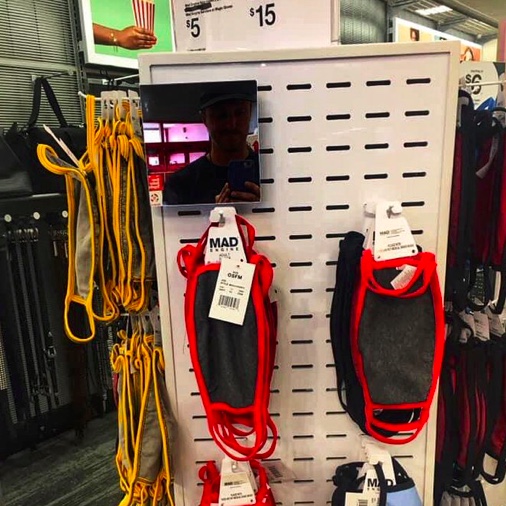
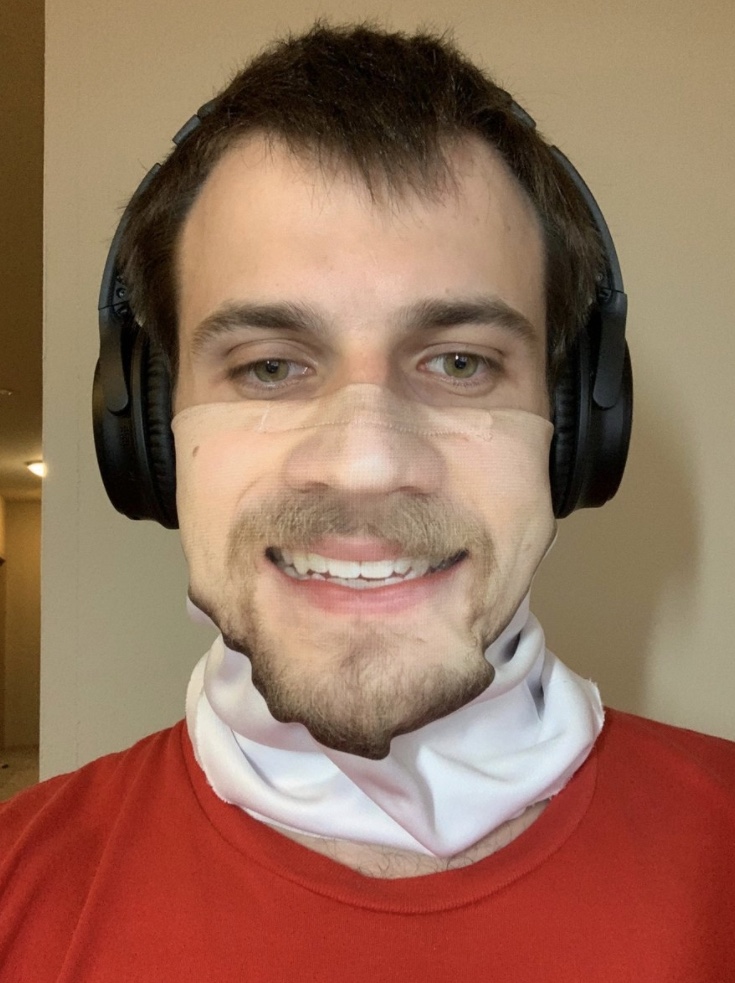
Ummm... maybe not. In many places, masks are mandatory, so you as well make it your own.
There's a mask for every fashion and fandom, and there can also be a mask for every face. People order custom-made masks with photos of their face on them to try and achieve a realistic look. Try being the most important word.
Here's another funny and creative way to tell people to wear a mask...
Strip. If I had a TARDIS I would try to meet three Queens but knowing my luck they'd be in mourning...
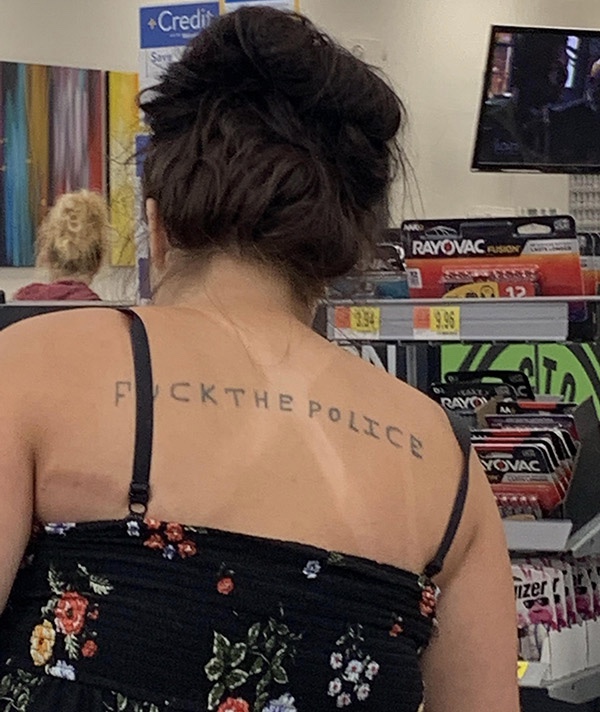
I'd show up at the funeral for King George VI who died in 1952. I was thinking of getting a new tattoo but someone had the same idea I had...
Wait. Something is wrong. Mindphuck! Haha. Speaking of tattoos... I was told at Walmart I would see some strange sights. I didn't believe it until I saw this...
Hmmmm. Sugar-free gummy bears might seem like a great idea in theory. But, like so many things being sold to us in a capitalist society, there is a catch. Anyone who's ever tried (or worse, binged) on sugar-free candy knows exactly what that catch is.
If you're not sure, just check out this reviews on an Amazon listing for a 1-lb. bag of Haribo SUGAR FREE Classic Gummi Bears.
Damn. So, my guest today Alan Silvestri has composed film scores for so many movies, I wonder if he's going to work on this one...

I bet it's going to be good. Hahaha. Okay, so, regardless of your personal dietary choices, nobody ever likes the person at the party who tries to preach to everyone about why gluten is the devil and raw-veganism Keto macrobiotic no-carb juiced smoothies are the only foods that humans were evolved to eat.
If you're passionate about nutrition, it's always nice to share your knowledge with other people especially if a dietary change dramatically impacted how you feel and see yourself. As much as we hate to accept it, we are often "what we eat," and eating healthier can really change your overall health. However, if someone isn't interested in hearing about why their favorite foods are actually horrible for their bodies or the environment, it's definitely a buzzkill to go off on a tangent about your food superiority around the meat and cheese board. Dietary restrictions are personal choices, and if you wouldn't want someone judging you for having them, you shouldn't judge others for not having them.
What happens, though, when you choose to change your family's diet? When a recent Phile reader decided to email me about a moral dilemma with his wife's newfound passion for vegetarianism I thought I'd help.

"Am I wrong for letting my kids eat meat despite my vegetarian wife?
My wife has suddenly gone vegetarian after watching a documentary about how animals are exploited when they are sent to be slaughtered. Neither of us have been vegetarian before and we rarely ate vegetarian meals.
Our family situation is that I work full time while she stays home to cook/clean/pickup kids from school, etc. This has always been fine and she is a great housewife. I never pressured her to be a housewife... this is what she wanted from the start. However, as she is now vegetarian, she refuses to cook any dishes with meat in it for me or our two kids (10 and 12). She has been a decent cook, however, she doesn't know how to cook many vegetarian meals just yet. And naturally, I am craving meat.
She INSISTS that I do not eat meat ever again and insists it upon our kids as well. We argued over this, but, I gave in and said I would try, but, no promises. My kids basically refuse to, but, since they aren't exactly old enough to cook for themselves they have to abide by whatever my wife packs them for lunch and dinner. Just to be clear, she explicitly asked me to not eat meat ever again, and I said I would try.
Here is the issue:
Every Monday night, my wife goes to dance classes and it is my responsibility to feed and entertain the kids. After a month of not eating meat, my kids were bugging me to get them some non-veg dishes. So, I made them promise not to tell my wife and I will take them to a restaurant of their choice. We went out and my kids ate fish and chips. I left the receipt in the car, and my wife found it a week later.
My wife was very upset at me, and said I should not have gone behind her back, and that I should not be contradicting her to the kids. I explained that I crave meat, and the kids do as well and it is not fair to impose her choices on to us.
Anyway, my wife won't budge from her position that nobody in our family is allowed to eat meat, and I won't budge from the fact that I should be allowed to eat meat when she is not around, and so should the kids. I am not asking her to make non-veg dishes, I am arguing that I (and the kids) should be able to choose to eat what I want.
Anyway, am I wrong for: lying to my wife, contradicting her parenting and also encouraging my children to hide secrets from my wife?" You shouldn't be encouraging the kids to keep secrets from your wife. It makes the kids think that keeping secrets from parents is a good idea and opens it up for other adults to get the kids to keep stuff from them. You should have had this battle with your wife before bringing the kids into the fray. Dietary choices that aren’t a medical requirement should be made by the person themselves, including children. You went behind her back after she forced you and the kids to abide by her new lifestyle.
She’s wrong for trying to force them to watch a documentary after they didn’t willingly choose to not eat meat. The kids want meat. They're old enough to know their own palate. If they're going to have a moral crisis about it, they're gonna have to do that on their own. You can't force a moral crisis on someone else. That's inception. And we all know how dangerous inception is. My parents were both vegetarians and didn't force myself or my sisters to be... we all made our own decisions. I was a vegetarian for years then one day craved chicken after they both passed and the rest is history. So, there you have it!
While this husband was wrong to lie, his wife really shouldn't inflict her newfound dietary changes on her entire family. Good luck, everyone! If you have a problem you want me to help with then email me at thepeverettphile@blogspot.com.


If you spot the Mindphuck then let me know. Okay, you know I live in Florida, right? Well, here's another story form this state...

A Florida man has been arrested and charged with possession of child pornography after deputies found thousands of images of child pornography on his phone. Because deputies also found images of the man sexually assaulting a dog, additional animal cruelty and bestiality charges are pending against the man.
The Volusia County Sheriff’s Office arrested 20-year-old Joshua Jobe of Volusia County, Florida after recovering Jobe’s phone from the scene of a robbery and ultimately finding 1,400 images of child pornography as well as a video of him sexually abusing a small dog on the device. Officers also found conversations on the phone in which Jobe talked about his desire to rape children and babies and boasting of having access to children with which he could have sexual contact.
Fortunately, however, there is no evidence to suggest that Jobe has actually had sexual contact with any minors of any age. Authorities added, though, that if any person has any evidence or information to the contrary to please contact the Child Exploitation Unit at 386-323-3574.
Meanwhile, the poor dog that was allegedly sexually abused by Jobe, which belongs to Jobe’s family, has been removed from the Jobe family’s home and is being cared for. This is, as it would happen, actually the second time Jobe has been caught sexually abusing his family’s dog. The first instance, which occurred in 2016, happened with a different dog that no longer belongs to the Jobe family. That family pet was ultimately taken into custody by Animal Services.
Along with the charges and information on Jobe’s crimes, Volusia County Sheriff’s Deputies made sure to point out that Jobe has autism and operates at a mental capacity younger than his actual age.
Regardless, Jobe is currently being held without bond.

Crow
Halloween eagle
Hmmm... That's almost funny.
So weird. Okay, now from the home office in Port Jefferson, New York here is...
Top Phive Things Said This Past Weekend
5. I think it's fucked up that for the 2020s we didn't even get the roaring' part like in the past. We just went straight to the depression.
4. Wondering how much of my life I've spent begging high school TV characters to apply to at least one safety school.
3. Why do we call them "olives" and not "Greece's pieces"?
2. Mommy can't play right now, she has to go on a pensive was and listen to her songs.
And the number one thing said this past weekend was...
1. I hate when people say, "The bug is more scared of you than you are of it." Did the bug tell you that?!
If someone farts at a poker tournament, no one will ever know who did it.
The 134th book to be pheatured in the Phile's Book Club is...
Jim Carrey and Dana Vachon will be on the Phile on Friday! Okay, let's see what is going on live in Port Jefferson, shall we?
It seems like a nice day there. I see the ferry on the right! I'll show you...
It's off to Bridgeport, Connecticut. Now for some...
Phact 1. In 1926, the visiting Ukrainian Head of State was assassinated in Paris with five shots from a revolver in broad daylight. The policeman who witnessed the crime walked over to the gunman and said calmly, “Is that enough?”
Phact 2. Apollo 13: The cast and crew flew between 500 and 600 parabolic arcs in NASA’s KC-135 airplane (nicknamed the “Vomit Comet”) to achieve real weightlessness. Each of the arcs got them 23 seconds of zero gravity. All of these flights were completed in 13 days. The actual KC135 used (NASA serial number N930NA) was decommissioned in 2000 after 27 years of service and is on display at Ellington Field.
Phact 3. The “Good Friday Fallacy” is the demonstrably incorrect belief that the pivotal Virginia Indian Uprising of 1622 began on “Good Friday.”
Phact 4. In 2012, Israel ranked as the 2nd most educated country in the world.
Phact 5. There is another version of Batman where Bruce Wayne dies and his father becomes Batman and his mother becomes the Joker.
Today's guest is an American composer and conductor of film and television scores. His credits include the Back to the Future film series, Forrest Gump, and several Marvel Cinematic Universe films, including the Avengers films, and the television series "Cosmos: A Spacetime Odyssey." He is a two-time Academy Award and Golden Globe Award nominee, and a three-time Saturn Award and two-time Primetime Emmy Award recipient. Please welcome to the Phile... Alan Silvestri.
Me: Hey, Alan, welcome to the Phile. I'm so excited you are here! How are you?
Alan: I'm doing great, thank you. How are you?
Me: I'm doing great as well. Okay, so as I said in the intro you have written the scores for so many amazing movies, Alan. Whenever you hear your music, how do you feel?
Alan: Well, it's very unique wen I hear my scores.
Me: Being a conductor if you are out in public and hear your music playing do you start waving your arms like you're conducting, or wish you had a baton? Hahaha.
Alan: No, not at all... maybe sometimes I might move my hands.
Me: I knew it! So, you have worked with Robert Zemeckis on a lot of films, sir. What was the first one you worked on with him and how did you get that job?
Alan: It was Romancing the Stone. I was asked early on when I met Robert Zemeckis on the phone to write something for a scene which he described over the phone. I think it's the reason I wound up being invited do his film and as it sits in film today it's very much like what I brought and played for him. So it's a very special cue for the life of Robert Zemeckis and myself together.
Me: So, the next film was Back to the Future. I love that score! Did you watch the movie first before you did the score?
Alan: This was a situation where I met with Robert Zemeckis, he was on the set filming what actually became the Enchantment Under the Sea dance so he was still in the shooting process. It was a very busy day for him with all of these actors on set and we didn't have much time to converse but he at one point turned to me and he said, "Here's what I'm thinking, Al, this score has to be really big." He held both of his hands over his head as he described this. So I knew somehow that he was looking for scope and I knew we needed a theme with heroism, adventure, something that could be played broadly and heroically but could possibly be played quietly, intimately. It was very much like writing a song. It has a very song form... A,A, B, A form and it was one of those things that just came rather quickly and it seemed to accomplished what was being asked of me.
Me: A lot of scores in the 80s weren't done traditionally with an orchestra I don't think, but Back to the Future was. Was that intentional?
Alan: Absolutely it was intentional. We did have some music of the day in the day in the film. We had those fantastic Huey Lewis songs, we had some classic rock and roll with Chuck Berry, we had a wide range of music but there's something about an orchestra and the orchestra playing the emotional side of a film that brings a kind of timeless quality to the picture. Pop music and very often synchronized music in a way will time stamp itself.
Me: Did you imagine that you would be still talking about your collaboration with Robert Zemeckis in the year 2020, after all these years?
Alan: It's a complete miracle. I actually had a great chat with him recently. I think we are now working on our 23rd film together. It's just an incredible experience for me and I believe for him to have a relationship like that that has gone on that long... gone to so many different places. I would have to say directly there is a lot of love and trust that comes from a long term relationship that's just lovely to live in and live with.
Me: So, I have to mention Who Framed Roger Rabbit, sir. I love that score and that movie so, so much!!! So, when you wrote the score for a scene how much of emotion do you think your music is giving the viewer? Does that question make sense?
Alan: Give me an example of what you mean, Jason.
Me: Okay, in Who Framed Roger Rabbit, Jessica's theme has a very cool saxophone sound and people back then were getting "excited" about her, even though she was animated. Do you think that saxophone playing and that sultry music helped with that?
Alan: Well, these are great questions and they really have to always be in service of the film and the directors vision of the film. One of the great benefits of working with a world class brilliant film director is they get their intention on the film. And so as a composer when you see for instance Jessica Rabbit walking out into that theater, into that club, there's no doubt what Robert Zemeckis is hoping what we'll feel and how we would be moved by that. And at that point all one has to do is follow his lead.
Me: Alan, what movie earned you your first Academy Award nomination?
Alan: That was Forrest Gump, and that was a piece of music that most of the people don't immediacy recognize.
Me: That was one movie I didn't like... so much running! I would not recognize that score if I heard it. Was that a fun score to write?
Alan: I love the opening to the film and it is a visually pure introduction to Forrest Gump.
Me: So, when you were writing that music did you picture a feather falling to the ground? Haha.
Alan: There was no feather and Bob stood in front of a good sized monitor and he had his hand kind of floating back and forth across the screen, standing right in front of me and describing the motion of this thing and it goes all the way right until he puts his hand on Forrest's foot at the end of the sequence and he said, "And it lands right there." He said, "All you have to do..." Which he very often said, "all you have to do is write something that essentializes the entire film." That usually evokes a pain in the out of my stomach. And I sat at the piano in the following morning and I started to think well, Forrest is a pure soul. Forrest is childlike, he's not childish. And on and on and on, and the idea of a nursery rhyme sensibility seemed to make some sense. The idea of incorporating something that evokes he sense of floating makes some sense.
Me: Who are some of the other directors you enjoyed working with, Alan?
Alan: James Cameron, Steven Spielberg, and Nancy Meyers.
Me: You also did the score for the film Castaway, which is another movie I can't think what the score is. Why is that?
Alan: A lot of people think how quiet the movie is. Tom Hanks doesn't speak for a couple of words for most of it.
Me: So, what kinda conversation did you have with Robert about how to score a film that's so quiet?
Alan: Well, this was a tremendous challenge on so many levels. There's always this sense of can the music not intrude on the story and yet still support and be part of the telling of the story. There was a level of reality that I think Robert Zemeckis and Tom Hanks inspired to in this film. Their were people who wanted to have a score all through the island, wanted to have a score for the plane crash and it's a natural thing to want to explore. Bob never kind of subjected me to any of that, he really let me have my reaction to the film. I remember sitting there with him when we were talking and about to talk about the music and we're half way through the film and I still didn't feel that we should have any music. He let me at least try this idea. I told him that I had a mock up that I just done, I had a theme for Castaway and something I could show him. I played him the cue where Tom had just broken free of the waves and look back at the island and the score makes its first appearance. I played the whole cue for him and he said, "That's beautiful, Al." And I drove him back to the airport and he allowed that film to be spotted in the way it was. I think it was very bold on his part and again I think time again has shown that his instincts were right about that. It was a very valid way to approach the score for Castaway.
Me: Do you ever write lyrics as well? There were songs in The Polar Express.
Alan: It's very interesting. All of the songs in The Polar Express were written by Glen Ballard and me. I had not done a tremendous amount of songwriting but the need was a pouring from the very first moment we met. We somehow didn't pigeonhole each other in terms of how we would approach the writing a song. We have always approached our songwriting something that we are both always feeling free to enter the process both lyrically and musically. It has continued to this very day, it is now a long time relationship, creative relationship for me and for Glen. It's again one of those things where the level of trust and the joy of the freedom that we both can exercise in that relationship is breathtaking.
Me: You wrote a lot of scores for a lot of Marvel movies, which is very cool. Is composing music for a superhero franchise different for you?
Alan: Not really. First of all it was amazing to receive an invitation to join a completely different universe. I saw Marty McFly and Doc as superheroes. I've seen many characters in films I've done as superheroes. Of course the imagery of the Avengers warrants a level of power and a level of scope and the music that needs to be there or the music wild not be able to sustain its part of the overall image. But big stories, big adventures, the type of archetypal characters and events are really what a superhero movie is about. It's bigger than life and certainly The Avengers is that kind of film and has to tell its stories on that level... of original love.
Me: Wow! Alan, I have so many questions to ask you but I know you need to go. Thanks so much for being on the Phile, sir. Please come back again.
Alan: Thank you so much, Jason. I will.
That about does it for this entry of the Phile. Thanks to Alan Silvestri for a great interview. The Phile will be back on Wednesday with musician Bruce Cockburn. Spread the word, not the turd... or virus. Don't let snakes and alligators bite you. Bye, love you, bye. Kiss your brain.
I don't want you, cook my bread, I don't want you, make my bed, I don't want your money too, I just want to make love to you. - Willie Dixon